Description
What happens when the warmth between two people suddenly disappears? When a conversation becomes strangely empty, or every word seems to deepen the distance? Do you find yourself trying harder to reach the other person, becoming certain that you know what is happening, or deciding you will never need anyone again? What happens when receiving care feels dangerous, when difference feels like abandonment, or when closeness seems to cost you your own existence?
Jungian analyst Nathan Schwartz-Salant explored these questions through his work with the interactive field. In his writing, the field is a shared space between people that can be experienced as having its own life and movement. Both people participate in it. Both can be affected by what happens there. He explored how this space can become a vessel for transformation, where previously hidden feelings and possibilities begin to emerge.
In this course, we will explore narcissistic false autonomy: the protective insistence that we can remain self-sufficient and unaffected by another person. What happens when needing someone feels humiliating? When receiving something valuable makes us feel exposed? Schwartz-Salant described how acknowledging need can threaten self-esteem and stir envy or rage. We will become curious about the vulnerability these defenses protect, including the vulnerability of those of us who find safety in always giving, understanding, or being indispensable.
We will also explore the fusional complex, with its longing for closeness and fear of losing oneself. We may reach urgently for connection, then pull away when someone comes close. We may experience another person’s separate wishes as a threat to our belonging. We may become caught in familiar positions: the one who knows and the one who is confused, the rescuer and the helpless one, the disappointed parent and the failing child.
These shifts can happen in small, ordinary moments. Someone offers care, and we dismiss it. Someone disagrees, and we feel the relationship slipping away. We begin explaining more intensely. We are determined to prove that we understand. We offer reassurance before the sadness can be expressed. Those of us who accompany others may feel an urgent responsibility to restore connection or make something transformative happen.
Our bodies participate in these encounters. We may notice a held breath, a tightening throat, a sudden blankness, or the impulse to turn away. Relational neuroscience offers specific ways to explore the importance of accompaniment. In a small brain-imaging study of married women facing the threat of electric shock, holding a spouse’s hand reduced activity in brain systems involved in responding to threat. The response also varied with the reported quality of the relationship.
Research on psychotherapy has also found an association between the resolution of ruptures in the therapeutic relationship and better treatment outcomes. We will bring this research into our exploration of Schwartz-Salant’s framework as we experiment with acknowledgment, responsiveness, and repair.
What unconscious contracts might still be shaping our relationships?
I must never need what you might withhold.
I must become indispensable so you will stay.
I must agree with you to keep your love.
I must pull away before I lose myself.
I must know what this means.
I must keep us hopeful, whatever I am feeling.
I must bring this relationship back to life.
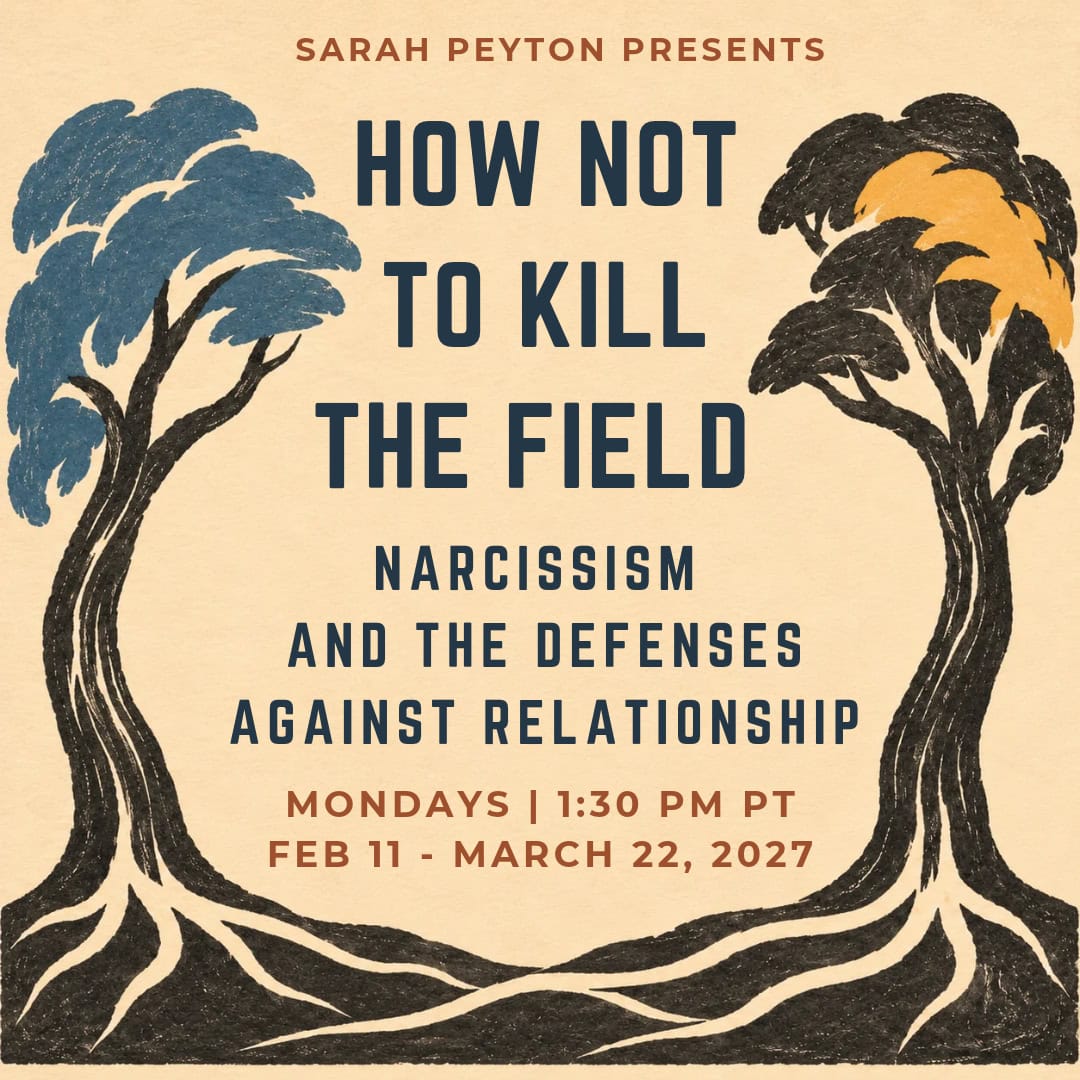
How Not to Kill the Field: Narcissism and the Defenses Against Relationship is a course about the protective patterns that constrain connection and the possibilities that emerge when these patterns receive warm, precise attention.
In this six-week experiential class, Sarah Peyton explores Nathan Schwartz-Salant’s work using the lenses of relational neuroscience, resonant language, gentle body awareness, time travel resonance, unconscious-contract work, and emergent constellations.
Together, we will become curious about the ways we protect ourselves from needing, receiving, being separate, and being changed by another person. We will explore the urge to explain, rescue, withdraw, insist, or make everything feel better. We will also make room for the experiences described by the alchemical nigredo: darkness, uncertainty, and the loss of a familiar sense of connection.
We will practice allowing grief, anger, envy, tenderness, and longing to have a place. We will explore what happens when we can remain curious about our own participation and allow another person’s experience to affect our understanding. We will turn toward the transformative third—the field experienced as a living presence—and the possibility of discovering something neither person could have planned.
Where?
The course will meet via Zoom. We welcome participants from all time zones who wish to learn asynchronously for some or all of the sessions. Recordings and visuals will be made available to those who are registered for the live program.
When?
Mondays | 1:30 PM – 2:55 PM Pacific Time
January 11 – February 22, 2027
**skipping February 1, 2027
Click Here to convert to your time zone
What To Expect
In this course, we will:
- Explore narcissistic false autonomy and the vulnerability of needing, receiving, and allowing another person to matter
- Study the fusional complex and the movement between longing for closeness and fearing the loss of oneself
- Discover how splitting and broken fields can organize relationships around familiar, rigid roles
- Investigate the need to know, explain, rescue, or produce a breakthrough, including these impulses in the person offering accompaniment
- Notice bodily and relational changes that may signal withdrawal, urgency, polarization, or a loss of felt connection
- Explore the broken mother field, family loyalties, and unconscious contracts surrounding need, separateness, anger, and aliveness
- Practice resonant language, time travel resonance, unconscious-contract inquiry, and emergent constellation processes
- Make room for uncertainty and difficult feelings while exploring containment, boundaries, acknowledgment, and repair
Participants will leave with a clearer map of these relational patterns and language for exploring them with warmth. They will have opportunities to discover and renegotiate protective contracts, recognize their own participation, and practice receiving care while remaining connected to their feelings and choices.
What You'll Learn
By the end of the six weeks, participants will have:
- A richer vocabulary for the interactive field, narcissistic defenses, fusion, splitting, and the transformative third
- A compassionate understanding of what defensive patterns may be trying to protect
- Greater awareness of the bodily sensations and impulses that accompany changes in connection
- More ability to distinguish an observation from an interpretation and remain curious about what another person experiences
- A process for discovering and renegotiating unconscious contracts around needing, knowing, pleasing, withdrawing, and being indispensable
- Practices for making room for closeness and difference within the same relationship
- Ways to acknowledge impact, maintain boundaries, and participate in repair
- An introduction to the unlived life: the feelings, capacities, and possibilities that have had little room to emerge
- More possibilities for receiving, self-compassion, curiosity, and shared aliveness
Who is This Course For?
Anyone from total beginners to experienced resonance practitioners are welcome. This course also supports space holders and people who are interested in therapeutic and emotional session-work, including resonance partners, empathy buddies, therapists and social workers.
This Course Includes Resonant Assistant Support
Assistant support is available during live classes for participants to practice breakout exercises with support.
Cost
$270 Early Bird
$300 Regular Price
Scholarship Information
Partial scholarships may be available for this course. For more information, please write to help@sarahpeyton.com after January 4, 2027.
Please Note:
- Your tuition payment is non-refundable (but it is transferable).
- This course will be recorded for those who want to learn asynchronously for some or all sessions.
- This work is not therapy and is not a substitute for therapy. If you have a sense that you would be destabilized by yourself or others speaking about difficult events, then this course may not be for you. While we hope that the processes and information that we share can be of use in your journey, we do not have the resources to support extreme psychological difficulties.