Description
Fawning happens when the nervous system has learned that safety, connection, or belonging depend on staying agreeable. We anticipate what other people need. We soften our truth, abandon our preferences, manage other people’s emotions, and say yes before we have had time to discover our own answer. We laugh or smile when people are not funny.
Fawning is most likely when three things come together:
- The relationship feels important.
- The other person’s response feels unpredictable or dangerous.
- The person does not experience themselves as free to fight, leave, disagree, or disappoint.
Some characteristics of fawning include:
- Apologizing before knowing whether we did anything wrong
- Agreeing with the other person’s version of events
- Taking responsibility for everyone’s feelings
- Rushing to soothe, explain, or repair
The patterns of fawning are deeply intelligent adaptations. They may have protected us in families, partnerships, workplaces, communities, or cultures where disagreement carried real relational consequences. But what once preserved connection can eventually make it difficult to know what we feel, what we want, and where our responsibility ends.
In this experiential class, we will practice the small, embodied movements that help transform fawning into authentic relationship. Rather than forcing ourselves to become more assertive, we will learn how to give the nervous system enough accompaniment, time, and safety for genuine choice to emerge.
Specific practices may include:
- Recognizing the bodily signals that appear before an automatic yes
- Pausing before answering requests or making commitments
- Separating empathy from agreement
- Noticing when we are monitoring someone else instead of sensing ourselves
- Finding the difference between generosity and fear-based caretaking
- Practicing small, low-risk expressions of preference
- Staying connected to ourselves when another person is disappointed
- Working with guilt, shame, and fear after setting a boundary
- Offering resonance to the younger selves who learned that authenticity was dangerous
- Identifying unconscious contracts such as “I must keep everyone happy” or “I am safe only when I am useful”
- Reclaiming healthy RAGE and DISGUST as clarity, protection, and life force
- Developing language to express our honest
“yes” and “no”, communicate about uncertainty, and change our minds - Practicing relationship in which both people are allowed to exist
The movement out of fawning is a difficult movement, which takes us out of our predetermined safe zone. It is also a movement toward self-care and existing. As we discover that our fawning is more historical than necessary in the present time, our ability to be authentic becomes more possible. We gain access to our dignity, and to our own boundaries and desires.
Where?
The course will meet via Zoom. We welcome participants from all time zones who wish to learn asynchronously for some or all of the sessions. Recordings and visuals will be made available to those who are registered for the live program.
When?
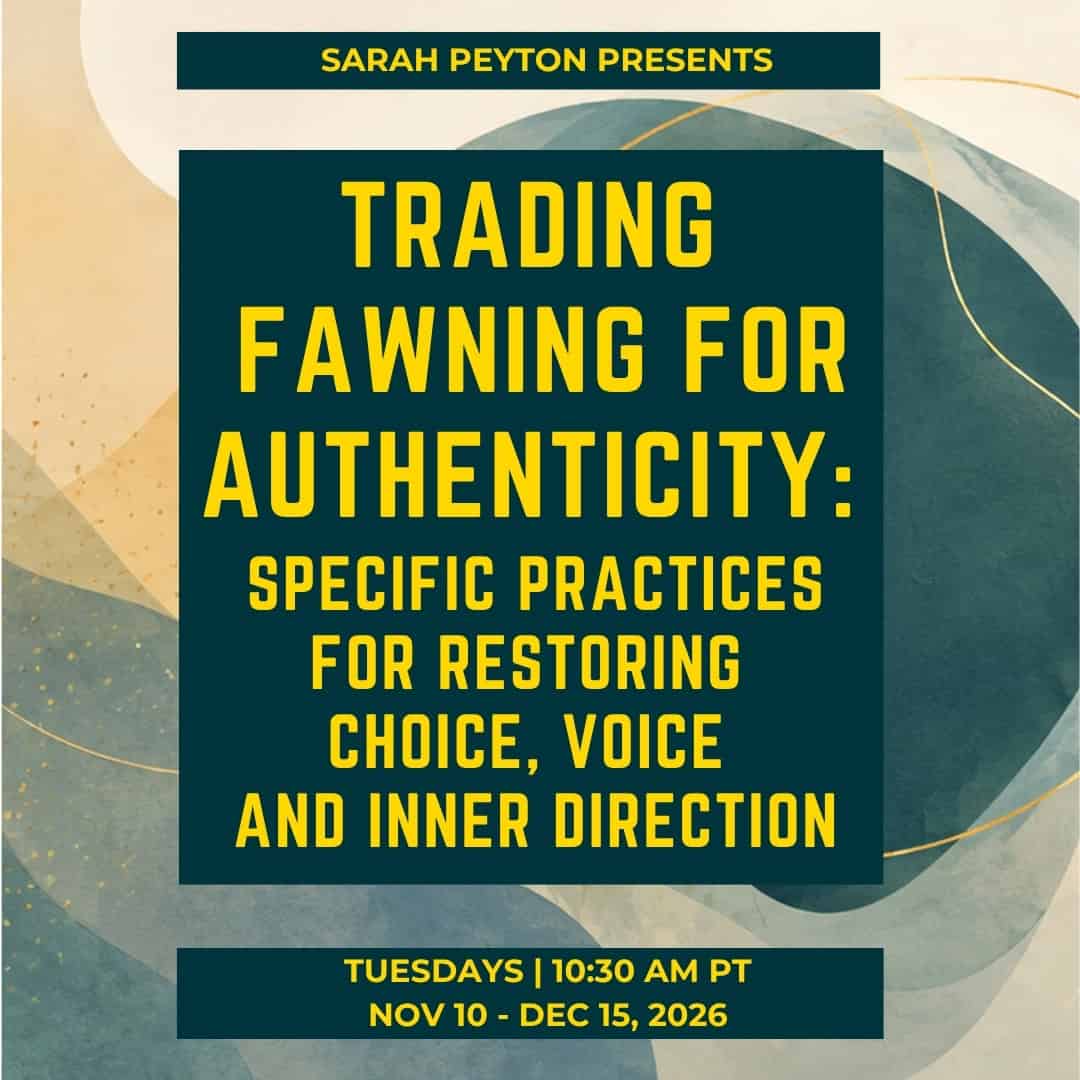
Tuesdays | 10:30 AM – 11:55 AM Pacific Time
November 10 – December 15, 2026
Click Here to convert to your time zone
What To Expect
Each class begins with relational neuroscience research into the nervous system and the phenomenon of fawning. The research is followed by a demonstration of a specific circumstance which can elicit fawning, and a little process work that takes us out of fawning. Then participants will have the opportunity to try out the work that has been demonstrated for themselves either in a breakout with another participant, or in a small group with an assistant, or in their own private zoom as a journaling process. Then, as a group, we will return to the main Zoom room for harvesting and questions.
What You'll Learn
Week 1 – Working with our responses to anger or disappointment
Week 2 – When the tone moves toward sexualization or uncomfortable “humor”
Week 3 – When conflict or disagreement arises
Week 4 – When the other person is distressed
Week 5 – When someone doesn’t like our boundary
Week 6 – When we receive criticism or negative feedback
Who is This Course For?
Anyone from total beginners to experienced resonance practitioners are welcome. This course also supports space holders and people who are interested in therapeutic and emotional session-work, including resonance partners, empathy buddies, therapists and social workers.
This Course Includes Resonant Assistant Support
Assistant support is available during classes. There are three ways this happens:
- In groups of three with one assistant and two participants, so that participants can practice the breakout exercises with support.
- In small groups, with 1 assistant and 3+ participants, with work with one participant occurring by lottery, and the remaining participants observing.
- Depending on assistant availability, the third option is 1-1 support to receive resonant processes like time travel and unconscious contracts for material that comes up during class.
Cost
$270 Early Bird
$300 Regular Price
Scholarship Information
Partial scholarships may be available for this course. For more information, please write to help@sarahpeyton.com after October 27, 2026.
Please Note:
- Your tuition payment is non-refundable (but it is transferable).
- This course will be recorded for those who want to learn asynchronously for some or all sessions.
- This work is not therapy and is not a substitute for therapy. If you have a sense that you would be destabilized by yourself or others speaking about difficult events, then this course may not be for you. While we hope that the processes and information that we share can be of use in your journey, we do not have the resources to support extreme psychological difficulties.