Description
What happens when one person becomes the emotional nervous system for an entire family, workplace, or community? And what about all the relational tracking: appointments, anniversaries, social commitments? Who remembers what matters? Are you the one who anticipates the disappointment, chooses the gentlest words, makes the difficult call, absorbs the tension, and makes sure everyone can keep going? Who remembers the losses, prepares people for change, explains one person to another, and returns after conflict to begin the work of repair?
Emotional labor began as a term for the work of managing feeling and emotional expression in paid roles. Sociologist Arlie Hochschild also wrote about the “emotion work” people do in their private lives, as well as the feeling rules that shape what we believe we owe one another. In this course, we will also discover the cost of the household mental load, caregiving, relationship maintenance, and the invisible work of keeping connection alive.
Our nervous systems are constantly taking in faces, voices, and shifts in emotional tone. Brain systems involved in attachment, social perception, and emotion regulation help us anticipate what may happen next and choose a response. These capacities support resonance, collaboration, and care. Early relational learning may also organize us around continual monitoring, especially when belonging has depended on being useful, calm, or emotionally available.
Much of this work happens more quickly than anything can be spoken. We scan the room, and make quick predictions. We rewrite our sentences before they come our of our mouths. We make decisions to soothe, apologize, or take care of the problem ourselves. Yes, our fawning is part of our emotional labor.
Research on workplace emotional labor has found strong associations between superficial actions, emotional dissonance, exhaustion, and reduced well-being. Experimental studies of emotional suppression have also found effects on the bodies and connection of both people in an interaction. The impact varies across individuals, roles, relationships, and cultures.
Why do some of us become the emotional organizers of every system we enter? What unconscious contracts say:
I must keep everyone okay.
I have to notice before anyone asks.
Someone else’s distress means I have failed.
It is my job to make this easier.
My needs create too much work.
I must understand everyone, even when no one understands me.
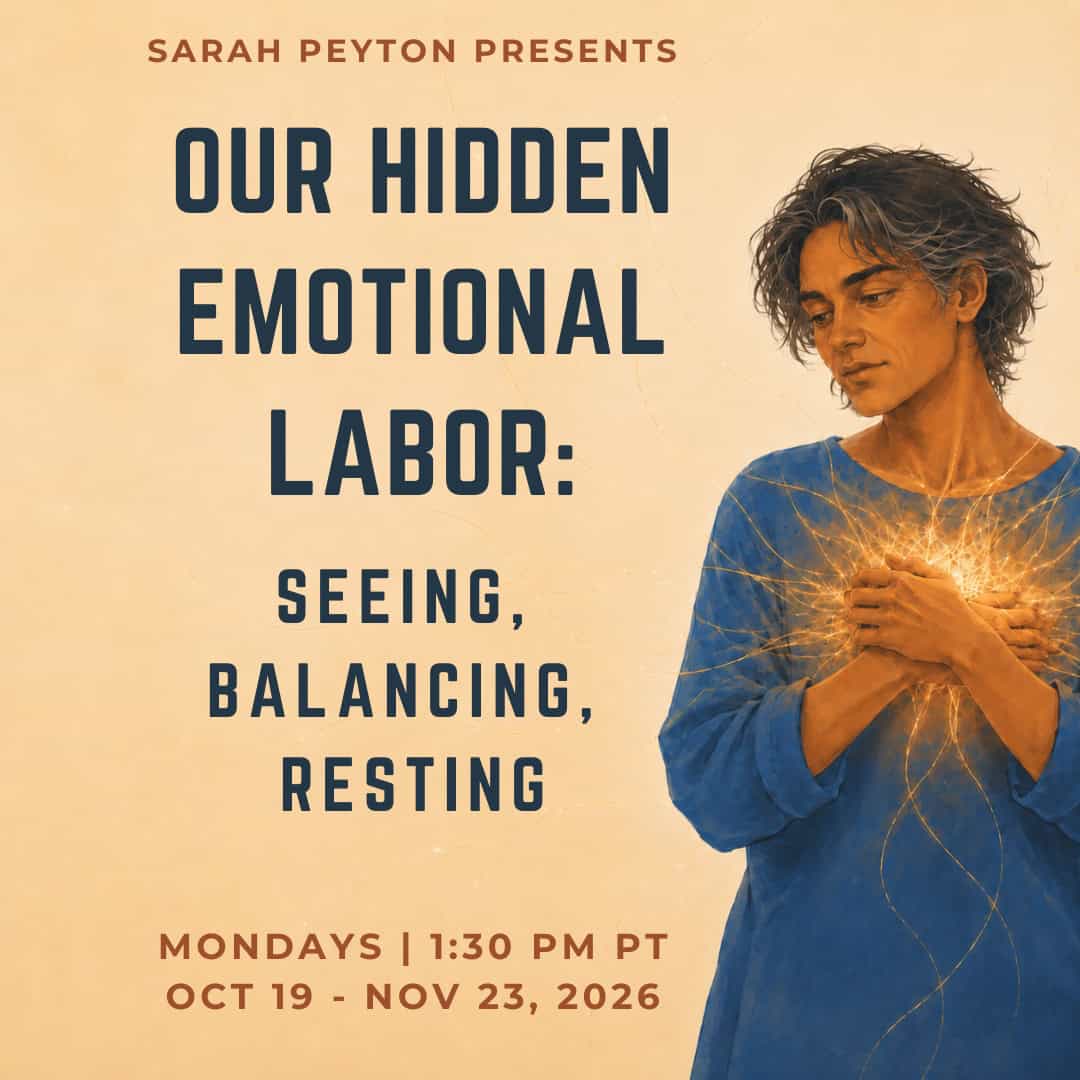
Our Hidden Emotional Labor is a course about the visible and invisible work we do to manage emotions, relationships, and belonging. In this six-week experiential class, Sarah Peyton pairs significant research with resonant language, gentle body awareness, time travel resonance, agreements with our family lines, and unconscious-contract work.
Together, we will become curious about the many forms of emotional labor: monitoring the room, carrying worry, preparing everyone for change, keeping track of needs, softening hard truths, translating between people, remembering what matters, and taking responsibility for repair. We will practice staying connected to ourselves as we care for others. We will make invisible work visible and discover shared care in which everyone’s humanity belongs.
Where?
The course will meet via Zoom. We welcome participants from all time zones who wish to learn asynchronously for some or all of the sessions. Recordings and visuals will be made available to those who are registered for the live program.
When?
Mondays | 1:30 PM – 2:55 PM Pacific Time
October 19 – November 23, 2026
Click Here to convert to your time zone
What To Expect
In this course, we will:
- Learn how resonant language can help us name invisible emotional, cognitive, and relational work
- Strengthen interoception and the ability to recognize our own sensations, emotions, impulses, and needs
- Notice the body’s early signals that emotional responsibility is beginning to gather
- Distinguish emotional labor, emotion work, household mental load, caregiving, co-regulation, and mutual care
- Explore the relational, family, ancestral, cultural, and workplace fields that shape our expectations and unconscious contracts.
- Practice staying connected to ourselves in the presence of someone else’s feelings
- Practice receiving care, allowing support, and making room for rest
Participants will leave with greater self-compassion for the pull toward emotional labor. They will have more language for the work they do and more ability to recognize the moment when care begins turning into over-responsibility. They will also release the unconscious contracts that prevent rest and self compassion, opening hearts and making room for laughter.
What You'll Learn
By the end of the six weeks, participants will have:
- A richer and more precise language for emotional labor and invisible relational work
- An understanding of how relational experience shapes emotional monitoring and over-responsibility
- A compassionate framework for patterns of pleasing, smoothing, anticipating, fixing, and carrying
- A method for discovering and renegotiating unconscious contracts
- More awareness of what belongs to them and what belongs to others
- Language for naming previously invisible work
- Practices for remaining present when someone else is uncomfortable, disappointed, angry, or sad
- A personalized collection of resonant and body-based regulation practices
- More spaciousness for rest and enjoyment
This Course Includes Resonant Assistant Support
Assistant support is available during classes. There are three ways this happens:
- In groups of three with one assistant and two participants, so that participants can practice the breakout exercises with support.
- In small groups, with 1 assistant and 3+ participants, with work with one participant occurring by lottery, and the remaining participants observing.
- Depending on assistant availability, the third option is 1-1 support to receive resonant processes like time travel and unconscious contracts for material that comes up during class.
Cost
$270 Early Bird
$300 Regular Price
Scholarship Information
Partial scholarships may be available for this course. For more information, please write to help@sarahpeyton.com after October 12, 2026.
Please Note:
- Your tuition payment is non-refundable (but it is transferable).
- This course will be recorded for those who want to learn asynchronously for some or all sessions.
- This work is not therapy and is not a substitute for therapy. If you have a sense that you would be destabilized by yourself or others speaking about difficult events, then this course may not be for you. While we hope that the processes and information that we share can be of use in your journey, we do not have the resources to support extreme psychological difficulties.